Weight Loss Tips for Women: 10 Practical Ways to Build a Healthier Approach
Global Obesity Group
A multidisciplinary team of specialists in Bogotá with extensive experience in the management of overweight, obesity, and metabolic surgery. This content is for educational purposes and does not replace a personalized medical evaluation.
If you have searched for weight loss tips for women, you have probably found plenty of advice telling you to eat less, exercise more, cut carbohydrates, skip certain foods, or follow a strict diet. But managing weight is rarely that simple.
At Global Obesity Group, we understand weight as the result of many interacting factors. Nutrition matters, but so do hunger and satiety, sleep, stress, physical activity, emotional health, metabolic health, medications, hormonal changes, medical conditions, and the stage of life you are going through.
That is why the best approach is not necessarily the fastest one. It is the one that helps you build changes you can sustain while also identifying whether something else may be making weight management more difficult.
Here are 10 practical weight loss tips for women, starting with habits you can apply in everyday life and moving toward situations where professional support may make a meaningful difference.
1. Build meals that keep you satisfied, not just meals with fewer calories

When trying to lose weight, it can be tempting to make every meal as small as possible. The problem is that a meal that leaves you hungry one hour later can make the rest of the day much harder.
Instead of thinking only about calories, we encourage women to ask another question: Will this meal actually satisfy me?
A balanced meal can include a source of protein, vegetables or fruit, foods rich in fiber, and an appropriate portion of carbohydrates and healthy fats according to your individual needs. These elements can make your meals more nourishing and easier to maintain over time.
For example, eating only a small salad for lunch may technically reduce calories, but if it leaves you extremely hungry in the afternoon, it may not be a practical strategy. Adding protein, vegetables, and another satisfying food may help you feel fuller and make your overall eating pattern easier to manage.
At Global Obesity Group, our nutritional approach is not based on punishing restriction. We look at eating habits, preferences, routines, hunger patterns, health conditions, and weight goals to help build a plan that makes sense for the individual woman.

Cirugía bariátrica: ¿en qué consiste y qué cambia realmente en tu cuerpo? Contenido escrito por
Weight Loss Tips for Women: 10 Practical Ways to Build a Healthier Approach Content written

La importancia de una alimentación saludable para controlar el peso y cuidar tu salud Contenido
Una Solución a la Obesidad

2. Pay attention to hunger and fullness instead of eating on autopilot

One of the most useful weight loss tips for women has nothing to do with eliminating a particular food. It is learning to understand why, when, and how you eat.
Sometimes we eat because we are physically hungry. At other times, we may eat because we are stressed, tired, bored, anxious, celebrating, distracted, or simply following a routine.
Try observing what happens before and after your meals. Are you very hungry because you have gone too many hours without eating? Do you regularly continue eating after you already feel satisfied? Does your appetite increase at a particular time of day?
This is not about judging yourself or trying to control every bite. It is about recognizing patterns.
Understanding hunger and satiety can also help us distinguish between a nutrition problem and a situation where emotions, sleep, stress, medications, or other factors may be influencing eating behavior.
3. Include strength training and more movement in your everyday life

Exercise does not have to mean spending hours at the gym or trying to “burn off” everything you eat.
Physical activity can support cardiovascular health, mobility, metabolic health, mood, and the preservation of muscle. For women trying to manage their weight, strength training can be particularly valuable because maintaining muscle becomes increasingly important as we age.
You also do not need to wait for a perfect workout routine before becoming more active. Walking more, taking the stairs when possible, standing up regularly during the workday, dancing, swimming, cycling, resistance exercises, or activities you genuinely enjoy can all contribute.
The best type of exercise is not necessarily the one that burns the most calories in an hour. It is often the one you can safely and consistently keep doing.
If joint pain, severe obesity, physical limitations, fatigue, or another health problem makes exercise difficult, we do not recommend simply “trying harder.” Those limitations can be part of the medical assessment so that movement is adapted to your current health and abilities.
4. Treat sleep as part of your weight management plan

Food and exercise usually receive most of the attention, but sleep can influence how manageable your other habits feel.
When you consistently sleep too little, you may wake up tired, have less energy to prepare meals or exercise, and find it harder to manage appetite. The National Institute of Diabetes and Digestive and Kidney Diseases also notes that insufficient sleep is associated with weight gain and may contribute to greater hunger and calorie intake. (National Institute of Diabetes and Digestive and Kidney Diseases [NIDDK], 2023)
If your days are very busy, improving sleep may sound unrealistic. You do not necessarily need a perfect nighttime routine. You can start by identifying what is keeping you awake: irregular schedules, screens late at night, stress, caffeine, caregiving responsibilities, insomnia, snoring, or poor-quality sleep.
Persistent sleep problems deserve attention, especially when they coexist with obesity, daytime sleepiness, or other symptoms.
5. Look at stress and emotional eating without guilt
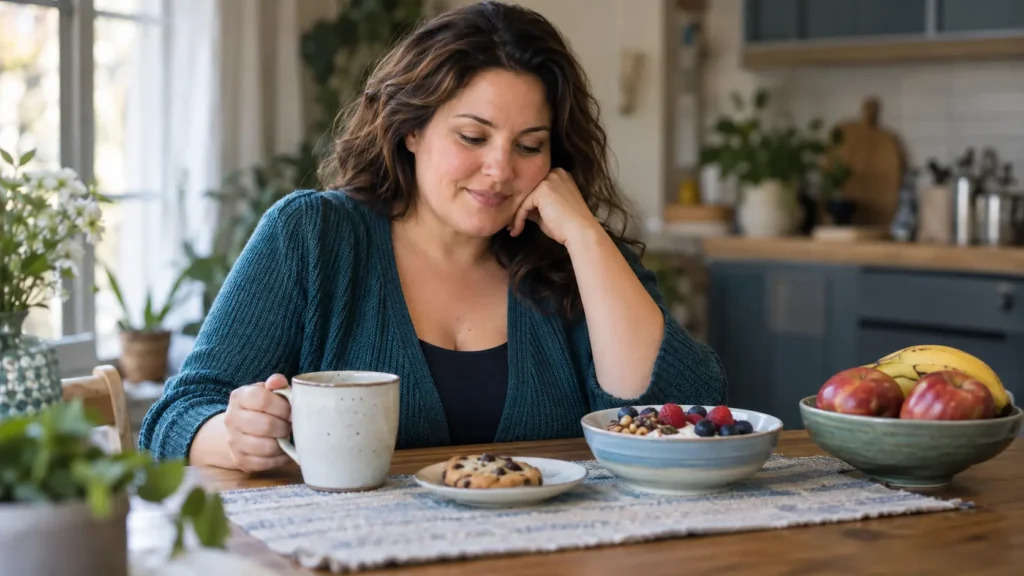
Eating is not only a biological act. It also has emotional, social, and cultural dimensions.
A stressful meeting, a difficult day, family responsibilities, anxiety, or exhaustion can change the way we eat. Some women notice that they snack continuously during stressful periods. Others restrict food during the day and lose control later. Some move between highly restrictive diets and episodes of overeating.
The solution is not always another meal plan.
Sometimes we need to work on the relationship with food, identify emotional triggers, develop different coping strategies, and challenge the all-or-nothing thinking that can accompany repeated dieting.
This is where psychological support can become an important part of weight management. At Global Obesity Group, we believe emotional health should be considered alongside nutrition and medical health rather than treated as a completely separate issue.
6. Stop looking for the fastest diet and focus on what you can maintain

A plan can produce changes on the scale and still be a poor long-term strategy.
Before starting a diet, ask yourself:
Could I realistically live this way for several months?
If the answer is no, the plan may be too restrictive.
You do not need to eat perfectly to make progress. In many cases, improving what happens most of the time is more useful than following an extremely strict plan for a few days and abandoning it afterward.
We prefer to focus on changes that can gradually become part of your routine: improving meal quality, planning ahead, reducing mindless eating, increasing movement, organizing portions, getting adequate sleep, and learning how to navigate weekends, celebrations, travel, and stressful periods.
Weight management is not a test of how much restriction you can tolerate.
7. Remember that women’s weight can change during different stages of life

A strategy that worked for you at 25 may not feel the same at 45, and that does not automatically mean that you are doing something wrong.
Pregnancy, the postpartum period, aging, perimenopause, menopause, changes in physical activity, medications, and certain medical conditions can change the context in which you are trying to manage your weight.
Menopause is a good example. Hormonal changes may play a role in changes in body composition and weight, but they are not the only explanation. Aging, declining muscle mass, changes in activity and eating patterns can also contribute. The U.S. Office on Women’s Health notes that losing weight may become more difficult after menopause and emphasizes healthy eating and physical activity as important components of weight management during this stage. (Office on Women’s Health, 2026)
The important point is not to assume that every weight change is “because of hormones,” but also not to ignore symptoms or life-stage changes that deserve medical evaluation.
8. If losing weight feels unusually difficult, look beyond calories

There comes a point when another diet may not be the answer.
If you have made repeated attempts to lose weight but continue struggling, we may need to investigate what is happening behind the number on the scale.
Medical conditions such as hypothyroidism or polycystic ovary syndrome can influence weight in some women. Certain medications may also contribute to weight gain. Sleep problems, metabolic health, family history, stress, depression, eating behavior, physical limitations, and other factors can be relevant as well. NIDDK specifically recognizes that weight can be influenced by lifestyle, sleep, medications, health conditions, genetics, and environmental factors. (National Institute of Diabetes and Digestive and Kidney Diseases [NIDDK], 2023)
That does not mean everyone needs an extensive battery of tests. It means that when weight loss has become unusually difficult, medical history and individual symptoms matter.
At Global Obesity Group, we evaluate the person rather than assuming that every patient needs the same diet or treatment.
9. Measure progress beyond the number on the scale

Weight is useful information, but it is not the only information.
Your body weight can fluctuate because of hydration, sodium intake, menstrual changes, bowel movements, or other short-term factors. Watching the scale every day and interpreting every increase as failure can make the process unnecessarily frustrating.
Depending on your goals and medical situation, we may also pay attention to changes in waist circumference, body composition, strength, mobility, energy, eating habits, sleep, blood pressure, glucose metabolism, laboratory results, or obesity-related health conditions.
Imagine that the scale has barely changed for two weeks, but you are walking more comfortably, sleeping better, planning your meals consistently, and becoming stronger. Those changes matter.
Successful weight management is not only about making one number smaller. It is also about improving health and creating behaviors you can sustain.
10. Know when it may be time to ask for professional help

Trying healthy habits on your own can be a reasonable starting point. But you do not have to continue repeating the same strategies indefinitely if they are not working.
Professional evaluation may be especially useful if you have made several serious attempts to lose weight without maintaining the results, have obesity or obesity-related health conditions, notice symptoms that could suggest a medical or hormonal issue, experience frequent emotional or uncontrolled eating, take medications that may affect weight, or feel unsure about which treatment is appropriate for you.
This does not automatically mean that you need medication or surgery.
It means that your weight deserves to be evaluated in context.
At Global Obesity Group, we can look at nutrition, medical and metabolic health, emotional factors, previous weight-loss attempts, lifestyle, and your personal goals before defining the next step.
Different weight loss methods for women: finding the right approach for you

One reason generic weight loss tips for women eventually reach their limit is that not every woman needs the same level of treatment.
Some women may benefit primarily from adjustments in nutrition and lifestyle. Others may need medical treatment, metabolic evaluation, psychological support, or a combination of several approaches. And for some patients living with obesity, bariatric treatment may become an option when there is an appropriate medical indication.
Nutrition and lifestyle support
Nutrition is often one of the foundations of treatment, but an effective nutritional plan should consider much more than a calorie target.
We assess eating patterns, food preferences, hunger and satiety, schedules, previous diets, medical conditions, lifestyle, and the woman’s relationship with food.
The goal is not to create the most restrictive diet possible. It is to build a strategy that can be followed in real life.
Medical and metabolic weight management
Sometimes previous weight-loss efforts do not produce the expected results because other factors may be involved. A medical evaluation can help review your weight history, health conditions, medications, symptoms, and metabolic health. When appropriate, treatment may include medical weight-management options in addition to lifestyle changes, always based on an individual assessment rather than trends or what worked for someone else.
Psychological support and your relationship with food
Weight management can become exhausting after years of dieting.
Some women arrive at our clinic knowing a great deal about calories and nutrition but still struggling with emotional eating, guilt, cravings, restriction, loss of control, or difficulty maintaining changes.
Psychological support can help us explore these patterns without reducing them to a lack of willpower.
When emotional and behavioral factors are influencing eating, addressing them can be just as important as changing what is on the plate.
Bariatric treatment when there is a medical indication
For women living with obesity, particularly when weight is affecting health or previous treatments have not provided sufficient results, metabolic and bariatric surgery may be considered after medical evaluation.
Procedures such as gastric sleeve or gastric bypass are not shortcuts and they are not treatments that every woman needs.
They are medical tools used in appropriately selected patients.
When we evaluate bariatric treatment at Global Obesity Group, the decision is not simply “Which surgery helps you lose more weight?” We look at the woman’s health, BMI, obesity-related conditions, eating patterns, digestive symptoms, previous treatments, medical history, and individual needs.
And surgery is not the end of treatment. Nutrition, medical follow-up, behavior, psychological support, and long-term habits remain important parts of the process.
At Global Obesity Group, weight loss is not a one-size-fits-all process

At Global Obesity Group, we want women to understand that needing more support does not mean they have failed. Sometimes healthy habits are enough to produce meaningful changes, but in other cases weight is being influenced by factors that deserve a closer look, such as metabolic health, sleep, emotional eating, medical conditions, medications, or repeated weight regain.
That is why we do not start by asking which treatment is the fastest. We start by understanding your history, your symptoms, what you have already tried, and what may be making progress difficult.
Our multidisciplinary approach can bring together nutrition, medicine, metabolic care, psychology, and bariatric treatment when medically indicated. Not every woman needs the same plan, and not every woman needs medication or surgery. Our role is to identify the factors affecting your weight and determine which combination of tools makes the most sense for your health, goals, and stage of life.
If you feel that you keep returning to the same starting point despite your efforts, a professional evaluation can help clarify what may need to change and what level of support could be most appropriate for you.
A healthier weight-loss plan starts with understanding what your body needs
There are plenty of weight loss tips for women that can help you improve your daily habits. But when those tips are not enough, the answer does not have to be another restrictive diet.
Sometimes the next step is understanding why losing weight has become difficult and what type of support your body actually needs.
At Global Obesity Group, we can evaluate your case through a multidisciplinary approach and help you explore nutritional, medical, metabolic, psychological, and bariatric options according to your individual situation.
Your weight-loss treatment does not have to look like anyone else’s. It should make sense for you.

Frequently asked questions about weight loss for women
What is the best way for a woman to lose weight?
There is no single method that is best for every woman. A sustainable approach usually combines appropriate nutrition, regular physical activity, sleep, behavioral changes, and attention to any health conditions that may influence weight. Women with obesity or related health problems may benefit from additional medical, psychological, pharmacological, or bariatric treatment depending on their individual evaluation.
Why can losing weight feel harder for some women?
Weight can be influenced by many factors beyond food intake, including muscle mass, sleep, stress, medications, genetics, health conditions, eating behavior, age, and different stages of a woman’s life. This is why two women following similar plans may not have identical results.
Can hormones prevent a woman from losing weight?
Hormonal and endocrine conditions can affect weight in some women, but hormones should not automatically be assumed to be the cause of every difficulty with weight loss. Symptoms, menstrual history, medications, age, medical history, and metabolic health can help determine whether further evaluation is needed.
Is strength training good for women trying to lose weight?
Yes. Strength training can help preserve or develop muscle and can be part of a broader plan that also includes aerobic activity and everyday movement. You do not need to become a competitive weightlifter; resistance bands, machines, free weights, or appropriately designed body-weight exercises can all be options depending on your health and ability.
When should I see a doctor if I am struggling to lose weight?
Consider professional evaluation if you have made repeated attempts without maintaining results, have obesity or weight-related health problems, experience unexplained or rapid weight changes, have symptoms that may indicate another medical problem, struggle with emotional or uncontrolled eating, or are considering weight-loss medication or bariatric surgery.
How do I know if I need bariatric surgery?
You cannot determine that from the scale alone. Bariatric surgery is considered according to factors such as BMI, health conditions related to obesity, previous treatment attempts, medical history, symptoms, and individual risks and benefits. A bariatric evaluation helps determine whether surgery is appropriate and, if so, which procedure may best fit your clinical situation.